Airborne Wind Energy

Practical use of AWE systems

Roland Schmehl

28 November 2025

CC BY 4.0

Outline

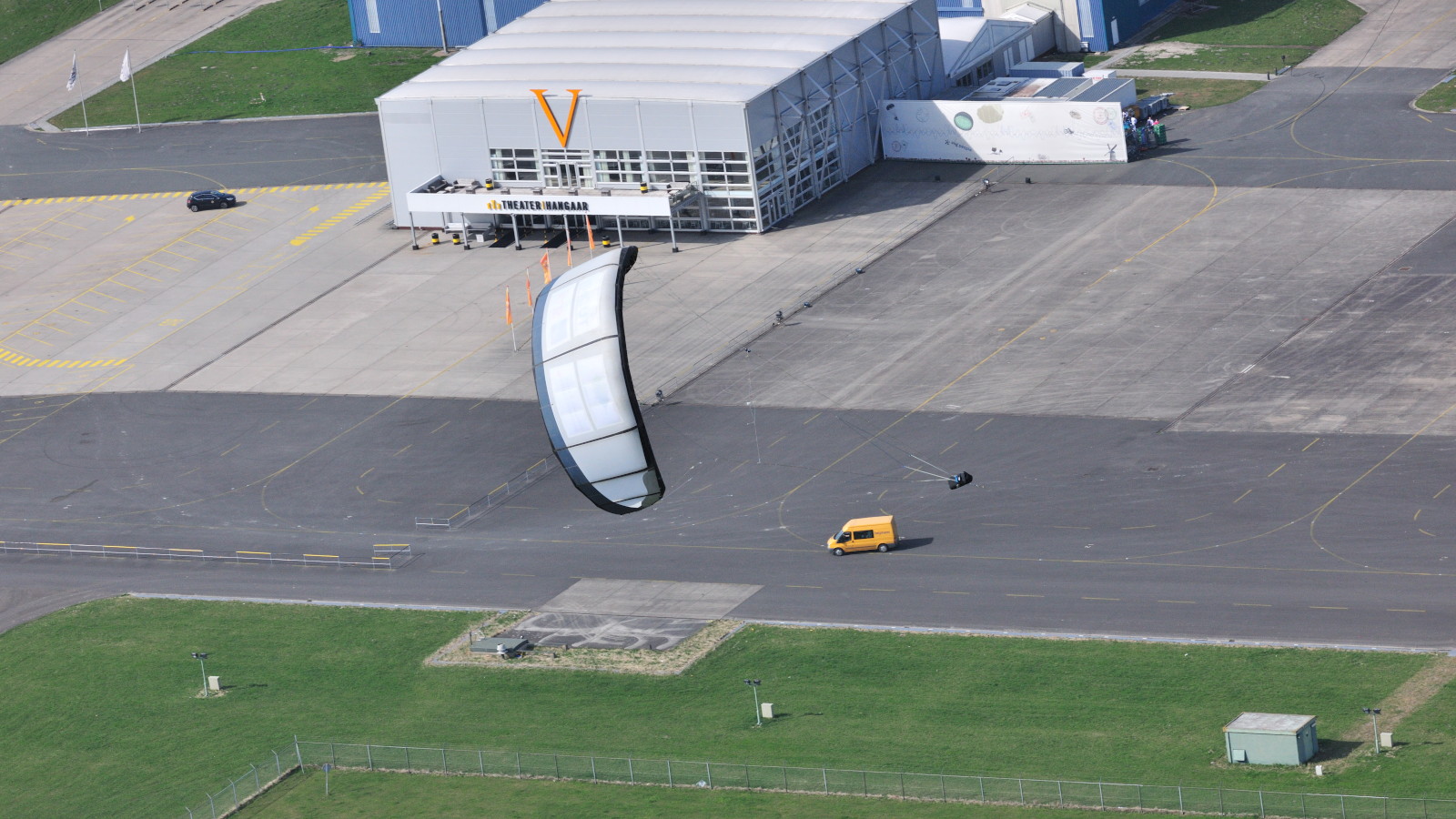
Kitepower

Learning objectives

In this lecture, practical aspects of using AWE systems for renewable energy generation are considered.

  • Investigate the wind resource available to AWE systems
  • Assess other aspects that are relevant to technology deployment
  • Position AWE in the future energy system:
    • Remote micro grids
    • Utility-scale deployments)
  • Understand the scaling of AWE technologies
  • Understand the economics of AWE technologies

Content

AWE resource potential 1

Wind needs to be treated as a statistical property, varying in space and time.

Consider available wind power density at a specific location and operational height.

The conversion process is not taken into account.

The analysis is described in Bechtle et al. (2019).

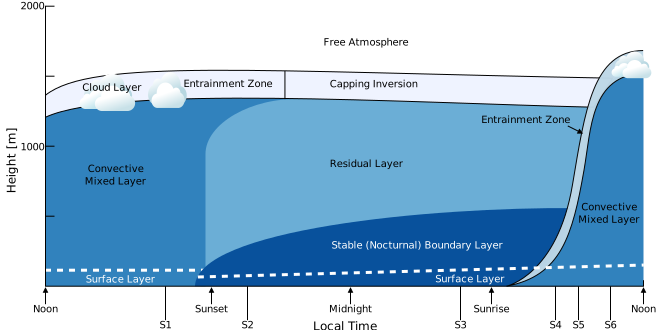
Atmospheric boundary layer

Stull RB. An introduction to boundary layer meteorology, 1988. doi:10.1007/978-94-009-3027-8

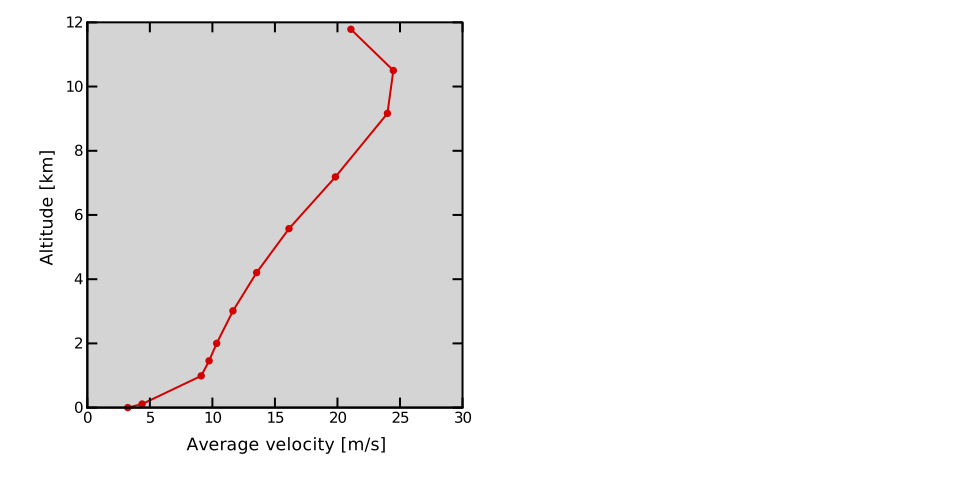
Higher altitude wind


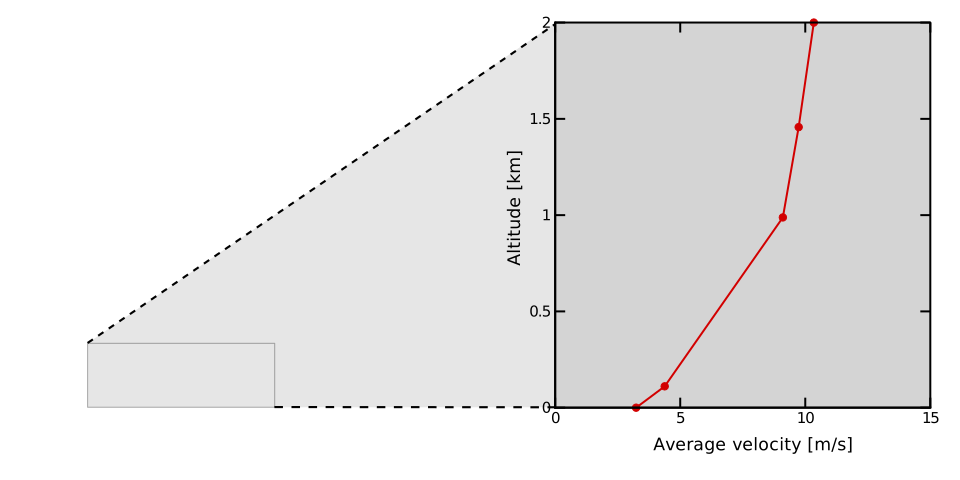
Average wind data measured from 1961 to 1980 at de Bilt, The Netherlands

Wind at sea level

Wind speed ~100 m, near sea level conditions

Wind in planetary boundary layer low

Wind speed ~1,500 m, planetary boundary, low

Wind in planetary boundary layer high

Wind speed ~3,500 m, planetary boundary, high

Wind in vorticity layer

Wind speed ~5,000 m, vorticity

Wind in jet stream layer

Wind speed ~10,500 m, jet stream

AWE resource potential 2

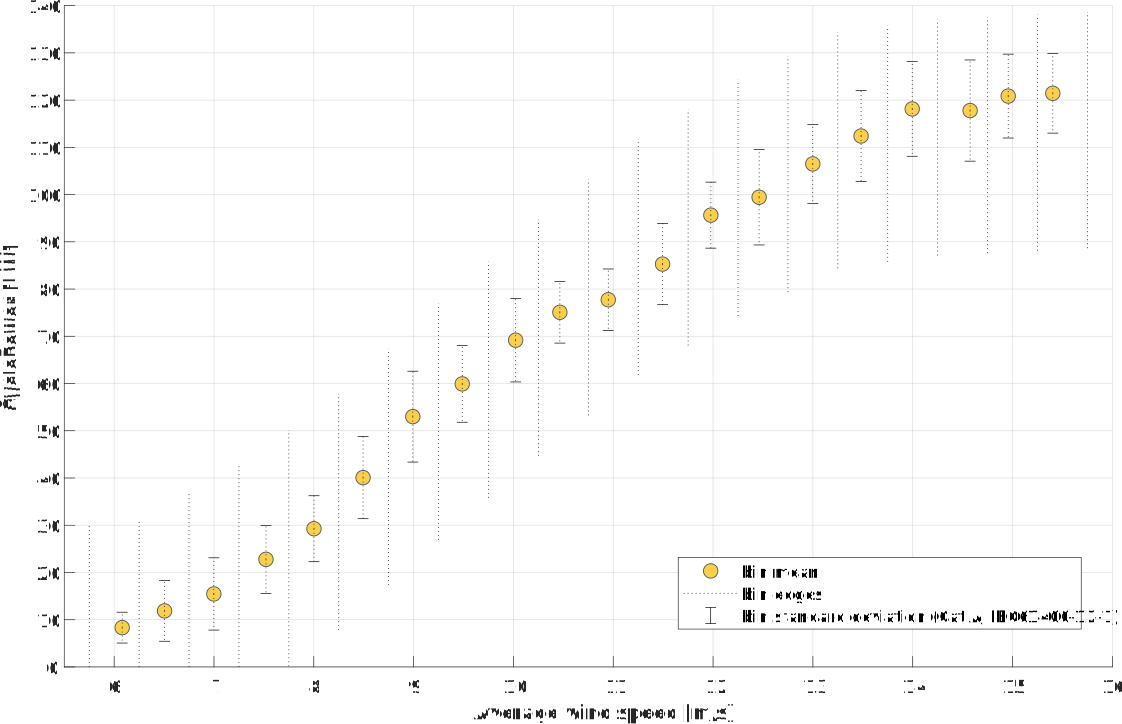
Filter and normalize wind speed data.

Reduce dimension of data using a principal component analysis (PCA).

Clustering wind profile shapes (k-means clustering).

Conversion process taken into account by quasi-steady model (QSM).

The analysis is described in Schelbergen et al. (2020).

Performance parameters

Power curve

Power Curve SKN-PN-14, released March 22th 2024

Annual energy production

Use the statistical wind speed data and the performance model.

The analysis is described in Schelbergen and Schmehl (2020).

AWERA toolchain used for AEP prediction at Maasvlakte II.

Technology deployment

What are the societal, environmental, economic, regulatory and operational challenges that need to be addressed for a successful deployment of AWE technology?

What is needed?

Approach

These are way too many aspects so we need to focus in this lecture on a few key aspects.

Operational safety

Max Dereta

Reliability and safety of AWES

The safety analysis is described in Salma et al. (2019).

Regulations

The assessment is described in Salma and Schmehl (2023).

Life cycle assessment

AWE and HAWT park

Van Hagen et al. (2023)

Scaling AWE systems

Kitepower kites in different sizes (2018).

Soft-kites

Kitepower kite with flattened wing area of 100 m2 (2018).

Recap: current prototypes

Developer Prototype name Electricity generation location Kite type Launching & landing concept Wing span (m) Wing surface area (m2) Kite mass (kg) Min.–max. operation height (m) Rated power (kW)
Skysails SKN-PN-14 ground soft wing static mast 15.6–22a 90b, 180c 170d 200-400 200
Kitepower Falcon ground soft wing winch 13.3a 47b, 60c 73d 70-400 100
Kitenergy KE60 Mark II ground soft wing winch 12.5a 42b, 50c 100-400 60
Toyoya Mothership v11 ground soft wing winch 8 8 5.2 300-600 1
CPECC Airpower ground parachute pilot parachute 40a 1256b 1480 500-3000 2400e
Wind Fisher MAG1 ground Magnus rotor winch 1.7 0.32f 1.0 0-50 0
EnerKíte EK30/Enerwing ground hybrid wing HTOL rotating arm 8-14 4-8 22.7 50-300 30
Mozaerog AP3 ground hard wing HTOL catapult 12 12 475 200-450 150
Kitemill KM1 ground hard wing VTOL quad-plane 7.4 3 54 200-500 20
TwingTec Twing (T29) ground hard wing VTOL tri-plane 5.5 2 25 up to 300 10
Windswept Kite Turbine ground rotary pilot kite 6×1h 6×0.2 10 1
someAWE MAR3 ground rotary pilot kite 4×1i 4×0.15 0.5
Kitekraft SN9 onboard box wing VTOL tailsitter 2.4 1.08 32 100j 12
Windlift C1 onboard hard wing VTOL tailsitter 3.8 0.95 11.3 30-100 2

a projected wing span
b projected wing surface area
c flat (laid-out) wing surface area
d excluding tether, but including suspended kite control unit and bridle line system
e rated generator power

f rotor diameter × width
g formerly Ampyx Power
h rotor diameter 4.48 m
i rotor diameter 3.5 m
j tether length

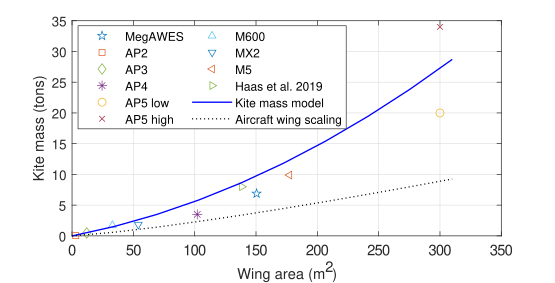
MegAWES kite

Eijkelhof and Schmehl (2022)

MegAWES kite

Eijkelhof and Schmehl (2022)

Fixed-wing kites

Joshi et al. (2024)

Effect of mass when scaling

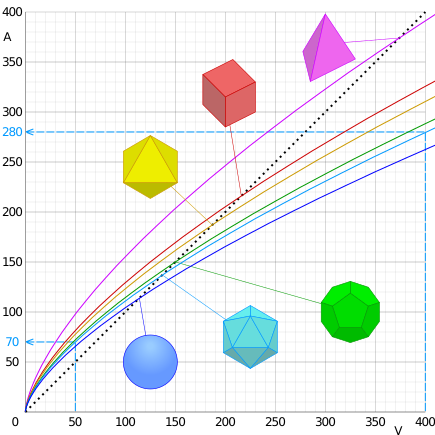
Square–cube law

When a physical object maintains the same density and is scaled up, its volume and mass are increased by the cube of the multiplier while its surface area increases only by the square of the same multiplier.

Effect of mass on cut-in wind speed

AWE in the future energy system

References

Bechtle, P., Schelbergen, M., Schmehl, R., Zillmann, U., Watson, S.: Airborne wind energy resource analysis. Renewable Energy. 141, 1103–1116 (2019). https://doi.org/10.1016/j.renene.2019.03.118
Eijkelhof, D., Schmehl, R.: Six-degrees-of-freedom simulation model for future multi-megawatt airborne wind energy systems. Renewable Energy. 196, 137–150 (2022). https://doi.org/10.1016/j.renene.2022.06.094
Faggiani, P., Schmehl, R.: Design and economics of a pumping kite wind park. In: Schmehl, R. (ed.) Airborne wind energy – advances in technology development and research. pp. 391–411. Springer, Singapore (2018)
Joshi, R., Schmehl, R., Kruijff, M.: Power curve modelling and scaling of fixed-wing ground-generation airborne wind energy systems. Wind Energy Science. 9, 2195–2215 (2024). https://doi.org/10.5194/wes-9-2195-2024
Kruijff, M., Ruiterkamp, R.: A roadmap towards airborne wind energy in the utility sector. In: Schmehl, R. (ed.) Airborne wind energy – advances in technology development and research. pp. 643–662. Springer, Singapore (2018)
Noth, A., Siegwart, R., Engel, W.: Autonomous solar UAV for sustainable flights. In: Valavanis, K.P. (ed.) Advances in unmanned aerial vehicles: State of the art and the road to autonomy. pp. 377–405. Springer Netherlands, Dordrecht (2007)
Salma, V., Friedl, F., Schmehl, R.: Improving reliability and safety of airborne wind energy systems. Wind Energy. 23, 340–356 (2019). https://doi.org/10.1002/we.2433
Salma, V., Ruiterkamp, R., Kruijff, M., Paassen, M.M.R. van, Schmehl, R.: Current and expected airspace regulations for airborne wind energy systems. In: Schmehl, R. (ed.) Airborne wind energy – advances in technology development and research. pp. 703–725. Springer, Singapore (2018)
Salma, V., Schmehl, R.: Operation approval for commercial airborne wind energy systems. Energies. 16, 3264 (2023). https://doi.org/10.3390/en16073264
Schelbergen, M., Kalverla, P.C., Schmehl, R., Watson, S.J.: Clustering wind profile shapes to estimate airborne wind energy production. Wind Energy Science. 5, 1097–1120 (2020). https://doi.org/10.5194/wes-5-1097-2020
Schelbergen, M., Schmehl, R.: Validation of the quasi-steady performance model for pumping airborne wind energy systems. Journal of Physics: Conference Series. 1618, 032003 (2020). https://doi.org/10.1088/1742-6596/1618/3/032003
Tennekes, H.: The simple science of flight: From insects to jumbo jets. The MIT Press, Cambridge, MA (2009)
Van Hagen, L., Petrick, K., Wilhelm, S., Schmehl, R.: Life cycle assessment of a multi-megawatt airborne wind energy system. Energies. 16, 1750 (2023). https://doi.org/10.3390/en16041750
Wilhelm, S.: Life cycle assessment of electricity production from airborne wind energy. In: Schmehl, R. (ed.) Airborne wind energy – advances in technology development and research. pp. 727–750. Springer, Singapore (2018)

Questions?


kitepower.tudelft.nl

// reveal.js plugins